This is part 1 of a 2-part series on what life could look like in 1500 Hijri if the Ummah were strong and united. Part 2 follows the same world into the workplace: 1500 Hijri (Business Edition).
It's the first of Muharram, 1500 Hijri…
You wake up to the sound of the athan, not the athan of Fajr, but the athan of qiyam, a tradition restored ever since the unification of the Ummah a few decades ago…
You get up and pray what Allah permits you to pray, thanking Him for His blessings and asking for His favors in this life and the next.
You hear the athan again. This time, it's Fajr. You quietly repeat after the mu'adhin as you open your bedroom window and see the lit windows dotting the neighborhood, homes where people are rising for Fajr and the start of their day and the new school year.
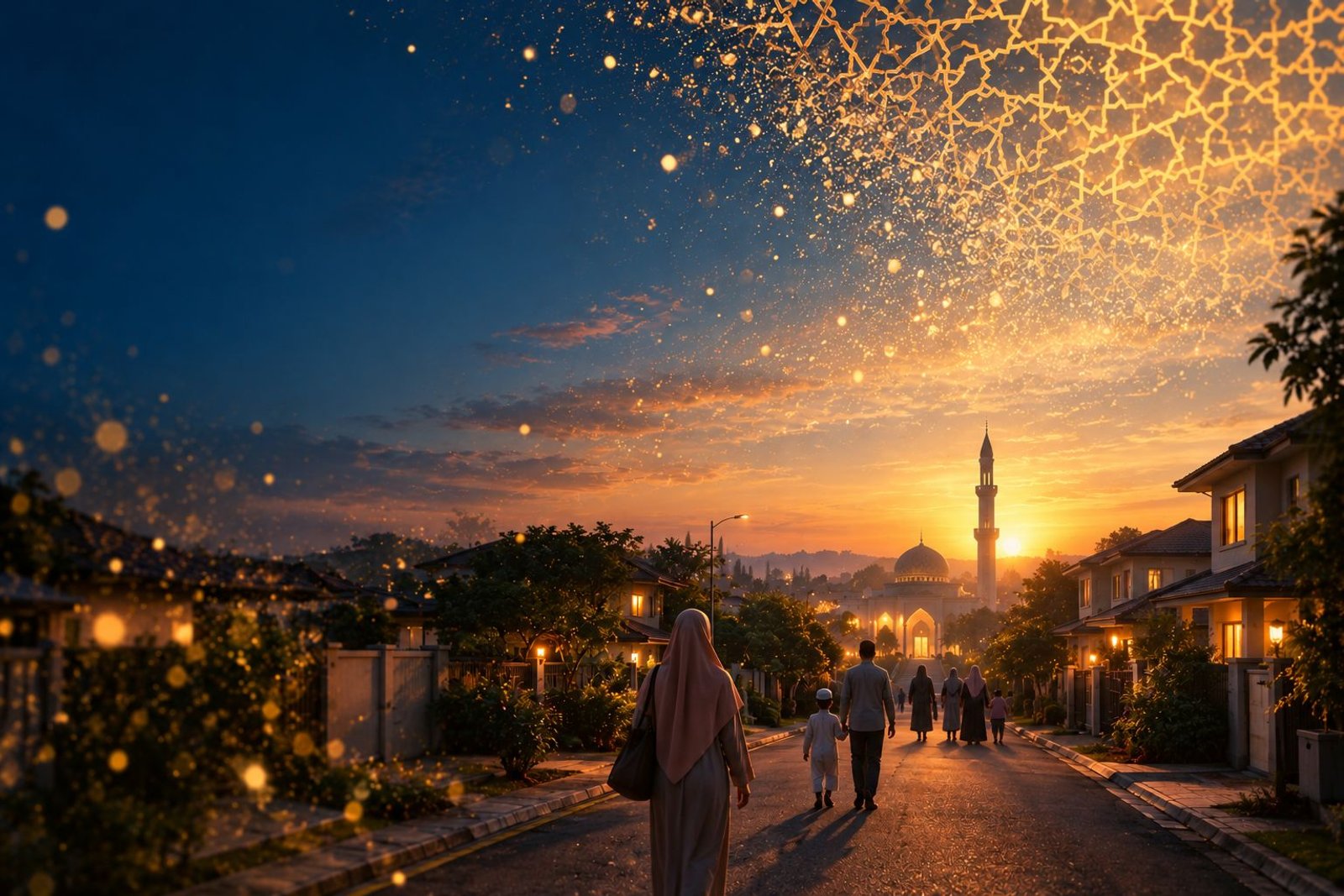
You head out to the masjid. The streets are alive with children skipping alongside their parents, all walking to pray Fajr before school and work begins.
At the doorstep of the masjid, you bump into a family who arrived in your city that morning. The father tells you they've come from Jakarta to study with your local scholars, do some business, and enroll their children in the masjid's education program.
"How long was the journey?" you ask.
"Two days by train," he says. "Just hopped on the Ummah train and got here."
You smile. You remember passports, visa queues, and being interrogated at borders between Muslim lands. Now anyone can travel, learn and trade anywhere from the Indonesian archipelago to the Atlas Mountains, and the Ummah's minds and markets have flourished because of it.
After Fajr, you sit to recite your morning athkar and read some Qur'an. You tap your ring, and Ihsan AI, your digital companion, offers today's tadabbur question, prepared by trusted scholars so your morning Qur'an goes beyond recitation into reflection.
Around you, the masjid fills with the voices of children, not only memorizing the Qur’an but discussing and debating the meaning of verses and how to apply them.
You remember the Ummah's dark ages, when the masjid was a place people visited only to pray, and it was locked between prayers. Now it has returned to its original purpose: the spiritual, learning and gathering heart of the community, full of young and old, men and women, rich and poor.
You step outside the masjid, and the morning sun tickles your eyes. Shops and businesses along the street are already open. A baker rolling up his shutter calls out to you: "Fresh bread until Dhuhr!"
That's the rhythm now. The day begins after Fajr, schools and businesses close by Dhuhr, and some reopen from Asr until Maghrib. The Ummah has organized itself around the prayers again.
You remember the absurdity of the 9-to-5. Worse, you remember a term called "996": 9am to 9pm, six days a week. Life revolved around work instead of worshipping Allah and being of use to others. People were burned out, stressed and depressed, and they called it ‘hustle culture’.
You shudder at the memory, and thank Allah for living in a time when people follow the fitrah, the natural way of living, shaped by the Prophetic routine, a time when Barakah Culture prevails.
You stop at your local coffee shop. Qur'an recitation plays softly in the background, and people listen attentively as they sip their chai or qahwa, writing their intentions in their digital notebooks. Today, many are writing intentions for the whole year and performing their annual Hijri reset.
At the next table, a young woman is on a call with team members in Nairobi and Istanbul. You overhear her say: "Let's aim to launch this product by the 15th of Rajab insha’Allah."
You smile. You still can't believe the Hijri calendar has finally been restored as the official calendar of the Ummah. Schoolchildren, shopkeepers, civil servants: everyone lives by it. Even non-Muslim companies have learned that if they want to do business with the Ummah, they must plan in Hijri.
Your ring buzzes. It's a video call from an old friend, and his face appears in front of you, grinning.
"Guess where I am?!"
He turns the camera. Behind him, the Dome of the Rock glows in the morning light, and the courtyards of Al-Aqsa are filled with worshippers.
You tear up. You remember lying awake in bed back in 1448H, scrolling through images and videos of the genocide in Gaza that you could do nothing about.
You wipe your eyes. It's been a few years since Al-Aqsa was liberated, and you still can't quite believe it.
"Alhamdulillah," you whisper and make an intention: you will pray in Al-Aqsa before next Sha'ban insha’Allah.
You finish your coffee. You remember that you have a waqf proposal due before Dhuhr. Since unification, many old awqaf have been restored to their intended purposes. The one you're working on was endowed centuries ago to feed and shelter travelers, and has stood empty for generations. Bringing it back to life will take work, and your proposal is the first step.
You walk to the central masjid nearby, with its library and co-working space. The tables are full: students, traders, engineers, people of every culture and background, including non-Muslims who come because it's simply the best place in the city to think and work. Alhamdulillah, you finish your proposal with time to spare and send it off.
Just before Dhuhr, you head to the masjid's qaylula room, one of many across the city's masajid, and lie down for a short nap. You wake to the sound of the athan. A volunteer comes around with hot towels and small glasses of tea, so everyone can freshen up for Dhuhr.
You pray Dhuhr in congregation, and after the salah the imam announces a janazah. You don't know the deceased, but you join the rows, and then the long procession to the graveyard. With work and school ending at Dhuhr, the hours until Asr now belong to these social obligations: following funerals, visiting the sick, caring for widows and the needy. You remember when people could only do these things on "weekends." Now there is no such thing. People choose which days they work, and everyone honors Friday, the master of the week.
By Asr, you're home. The family gathers for an early dinner, and everyone shares their day, and their intentions for the new year.
Your granddaughter has been reading an old book from the 1440s. She frowns and asks, “Why was the Ummah so weak back in those days?”
The adults at the table exchange a look. You open your mouth to explain, and realize you don't know where to begin.
Before Maghrib, you step onto your balcony to watch the sun set over the city. You recite your evening athkar and thank Allah for the blessing of Islam, and for the blessing of a united and strong Ummah, living up to its potential according to Divine design.
That was a day at home and in the masjid. But what does work look like when the whole Ummah runs on Hijri time? Continue to part 2: 1500 Hijri (Business Edition).
You've seen the day. Now build a small piece of it. The Productive Muslim Program is an 8-week journey to structure your days around your salah, not your schedule, so you can start living on Allah's time today, insha'Allah:


![[Prezi] Make Dhikr Your Friend!](https://cdn.sanity.io/images/2sxb14me/production/b44ddb06e9301fa7da29f257d35300f9932834b8-600x344.jpg)