
There was a joke in an organization I used to work for that said: when you had to go to the HR department, you needed to recite Surat Yasin on the way and ask Allah for protection. Alhamdulillah, things improved after a few years, and the joke was updated: now you only need to say your three Quls before heading to HR.
As much as we chuckled at this joke, it spoke to a reality that millions of people who work in corporate environments can relate to: the dreaded HR department.
A department people love to hate as it’s often seen as the roadblock to their career success and the leadership team’s favorite department to do their dirty work: pay cuts, restructuring, and layoffs delivered over a ten-minute Zoom call.
In this article, I’ll try to answer the question: Is there a better way to manage people that is based on our Islamic worldview? And how should a Muslim leader manage people differently from the standard corporate HR playbook?
To answer these questions, I’ll explore each stage of an employee lifecycle — from hiring to off-boarding — and try to figure out how Islam teaches us to manage people differently.
Before we start, let’s first redefine how we think of managing people.
Redefining HR
In my last article on decolonizing Muslim corporate culture, I wrote about how Muslim organizations — both in the West and in Muslim-majority countries — have imported the secular corporate culture wholesale without ever developing their own way of doing things. Sadly, in our race to 'catch up with the West' and to be seen as 'modern and professional', we imported the same corporate language and worldview about how companies should run, to the point that anything else feels backward or ‘unprofessional’.
Let’s take the term ‘Human Resources’ for example. This term was inspired by the work of Frederick Winslow Taylor, who saw machines and human labor on the factory floor as resources that management needed to allocate, optimize, and eventually write-off as they saw fit.
But from an Islamic worldview, human beings are not simply resources, they are Allah's honored creation. Allah says in the Quran:
۞ وَلَقَدۡ كَرَّمۡنَا بَنِيٓ ءَادَمَ وَحَمَلۡنَٰهُمۡ فِي ٱلۡبَرِّ وَٱلۡبَحۡرِ وَرَزَقۡنَٰهُم مِّنَ ٱلطَّيِّبَٰتِ وَفَضَّلۡنَٰهُمۡ عَلَىٰ كَثِيرٖ مِّمَّنۡ خَلَقۡنَا تَفۡضِيلٗا ٧٠
"Indeed, We have dignified the children of Adam, carried them on land and sea, granted them good and lawful provisions, and privileged them far above many of Our creatures."
Surah Al-Isra' [17:70]
If you think of the human being who joined your company as an honored creation of God, you’ll start to see them more as an ‘amanah’ (trust) than a resource. You’ll feel obliged to treat them with dignity, and take care of their physical, mental, and spiritual well-being whilst they are working for you. And when they leave your company, you hope they leave better than when they first joined, because that’s when you know you’ve fulfilled this amanah.
۞ إِنَّ ٱللَّهَ يَأۡمُرُكُمۡ أَن تُؤَدُّواْ ٱلۡأَمَٰنَٰتِ إِلَىٰٓ أَهۡلِهَا وَإِذَا حَكَمۡتُم بَيۡنَ ٱلنَّاسِ أَن تَحۡكُمُواْ بِٱلۡعَدۡلِۚ إِنَّ ٱللَّهَ نِعِمَّا يَعِظُكُم بِهِۦٓۗ إِنَّ ٱللَّهَ كَانَ سَمِيعَۢا بَصِيرٗا ٥٨
"Indeed, Allah commands you to render trusts to whom they are due, and when you judge between people, to judge with justice."
Surah An-Nisa [4:58]
So the first step to redefine how we manage people is to shift our mindset as leaders from ‘managing human resources’ to managing a trust that Allah will hold us accountable for.
And to help us make this mindset shift, we need to redefine the purpose of a business as well.
The Purpose of a Business Is Not What You Think
We're taught in business schools that the purpose of business is shareholder value maximization or, put simply: to make money.
My challenge to this definition is that almost every HR problem we complain about flows from the above definition: the cut-throat internal competition, the fight over headcount and budget, and the layoffs timed to protect a quarterly share price.
What if instead we redefined the purpose of business based on the purpose of life that Allah has defined for us?
وَمَا خَلَقۡتُ ٱلۡجِنَّ وَٱلۡإِنسَ إِلَّا لِيَعۡبُدُونِ ٥٦
"And I did not create the jinn and mankind except to worship Me."
Surah Adh-Dhariyat [51:56]
Just as a human being exists to worship Allah, what if a company existed to worship Allah as well.
You might ask: how?
A company worships Allah by managing what Allah has entrusted to the company — capital, labor, and time — to benefit His creation, and doing so in a way aligned with how Allah wants us to live on earth.
I want you to imagine that your company is owned by Allah, and you are simply managing whatever resources He has given you to deliver value on this earth — sustainably, ethically, and for His sake. How would that change how you manage your business? And more importantly, how would that change how you deal with your employees, customers, environment, and everyone affected by your business?
Allah made it clear that we are simply stewards on this earth, when He said:
وَإِذۡ قَالَ رَبُّكَ لِلۡمَلَٰٓئِكَةِ إِنِّي جَاعِلٞ فِي ٱلۡأَرۡضِ خَلِيفَةٗۖ
"And ˹remember˺ when your Lord said to the angels, 'I am going to place a successive authority on earth.'"
Surah Al-Baqarah [2:30]
This understanding of the purpose of business explains many of the incredible stories we hear of Muslim merchants of the past: The merchant who tells a customer not to buy from him, but from the trader next door, because that man hadn't sold anything yet that day. And the merchants who were the reason for the spread of Islam across Southeast Asia due to their ethical dealings, their trustworthiness, and their Barakah Culture way of doing business.
When you see your company as a vehicle to worship Allah and to fulfill your role as His khalifah on this earth, it changes how you manage your business and your people, and you start acting as a shepherd leader vs. a wolf leader.
Shepherd Leaders vs. Wolf Leaders
We often hear this hadith:
"Each of you is a shepherd, and each of you is responsible for his flock."
Sunan Abi Dawud 2928
A shepherd often doesn’t own the flock, they are simply entrusted with a flock. Just like you don’t ‘own’ the people in your company, they are simply entrusted to you.
When you think of yourself as a shepherd to a flock, there's a sense of responsibility towards that flock: to keep it safe from wolves and from sickness, to protect and nurture it, and to guide it to green pastures. A shepherd doesn't look at his sheep as dispensable resources towards making money. Each member of the flock has their strengths and weaknesses, and he has to work with what he has to help all of them reach greener pastures.
At a recent conference, Sh. Omar Suleiman shared a hadith where the Prophet ﷺ related that while a man was among his sheep, a wolf attacked and carried one off. The man chased the wolf until he rescued the sheep from it. And the wolf turned to him and said: “You have saved it from me; but who will guard it on the day when there will be no shepherd to guard them except me?” (Bukhari).
Sh. Omar reflected that when we are in any leadership position, we are either the shepherd — protecting our flock and caring for it. Or we are the wolf in shepherd’s clothing — predatory towards our flock, treating each sheep as a 'resource' to be consumed, driven by fame and wealth. In a related hadith, the Prophet ﷺ said:
"Two hungry wolves sent in the midst of a flock of sheep are no more destructive to them than a man's greed for wealth and fame is to his Deen."
Riyad as-Salihin 484
Sadly, greed for wealth and status is the operating system for most leaders today. Every leader is trained to be ‘efficient’ and ‘effective. But how many are trained to be ‘ethical’ and ‘God conscious’ — especially in how they manage people.
All the above was a preamble to exploring what it means to manage people as an amanah. Now let's explore what that means in practice at every stage of the employee lifecycle.
1. Hiring as an Amanah
When one of the daughters of Shoaib (peace be upon him) — recommended that her father hire Musa (peace be upon him), she gave two reasons:
قَالَتۡ إِحۡدَىٰهُمَا يَٰٓأَبَتِ ٱسۡتَـٔۡجِرۡهُۖ إِنَّ خَيۡرَ مَنِ ٱسۡتَـٔۡجَرۡتَ ٱلۡقَوِيُّ ٱلۡأَمِينُ ٢٦
"One of the women said, "O my father, hire him. Indeed, the best one you can hire is the strong and the trustworthy.""
Surah Al-Qasas [28:26]
Strength is technical competency, and it is not optional. You can be a great person to work with, but if you're not competent, you'll be a burden on the company. Similarly, trustworthiness and good character shouldn't be optional either. You can be brilliant, but if you cheat, lie, or create a toxic environment in the workplace, you also drain the company's time and resources.
Hiring managers often spend so much time focusing on technical skills, hence the IQ tests, EQ tests, psycho-metrics, assessment centers. But we don't have the language or the mechanism to test for character, other than asking former employers for a reference and hoping they're honest about the person we're trying to hire.
One of my friends who runs a large construction company in Türkiye told me that his father, who founded the company, kept repeating one prophetic saying:
لَا إِيمَانَ لِمَنْ لَا أَمَانَةَ لَهُ، وَلَا دِينَ لِمَنْ لَا عَهْدَ لَهُ
"There is no faith for one who has no trustworthiness, and no religion for one who does not honor his covenants."
Mishkat al-Masabih 35
So he weighs character as heavily as technical skill whenever he hires a person.
But how do you hire for trustworthiness and character? Below are some tips:
What if you find someone who's really good but a bit rough around the edges? Maybe they're Muslim but don't value Islamic teachings. Or they're non-Muslim, and don't understand the concept of barakah or Ihsan?
That's the question I'd put to you about your own company: Is this a place where someone rough around the edges could actually grow professionally and spiritually?
If it is, and the person is coachable, hire them. When someone joins your company, your intention should be that when they leave, they leave better than when they came. And that says a lot more about your company culture and your work environment than any ‘best place to work’ award.
If hiring was simply a resource decision, the hiring question is simple: Can this person do the work and can we afford them? But when hiring is treated as amanah, it’s more complicated but also more fulfilling long term.
2. Compensation and Benefits
When you've decided to hire someone, the discussion pivots to what you're willing to pay for their service.
As a leader, you often try to pay either as little as possible to save your costs, or as much as possible to attract them to join your company instead of your competition.
I believe that from an Islamic worldview, the question should be: What is the haqq (right) of this role?
When it's a discussion about haqq rather than what I can afford or what I can get away with, both employer and employee can enter a negotiation based on a fair assessment of what the work demands and a fair price that both can agree to.
So how do you actually work out the haqq value of a role? Ask four questions:
As business owners, we often think of the first 3 questions, rarely about the fourth. That’s why it’s important for both parties to be transparent about salary negotiations. The Prophet ﷺ said about transactions:
حَدَّثَنَا سُلَيْمَانُ بْنُ حَرْبٍ، حَدَّثَنَا شُعْبَةُ، عَنْ قَتَادَةَ، عَنْ صَالِحٍ أَبِي الْخَلِيلِ، عَنْ عَبْدِ اللَّهِ بْنِ الْحَارِثِ، رَفَعَهُ إِلَى حَكِيمِ بْنِ حِزَامٍ ـ رضى الله عنه ـ قَالَ قَالَ رَسُولُ اللَّهِ صلى الله عليه وسلم " الْبَيِّعَانِ بِالْخِيَارِ مَا لَمْ يَتَفَرَّقَا ـ أَوْ قَالَ حَتَّى يَتَفَرَّقَا ـ فَإِنْ صَدَقَا وَبَيَّنَا بُورِكَ لَهُمَا فِي بَيْعِهِمَا، وَإِنْ كَتَمَا وَكَذَبَا مُحِقَتْ بَرَكَةُ بَيْعِهِمَا " .
"Narrated Hakim bin Hizam: Allah's Messenger (ﷺ) said, "The seller and the buyer have the right to keep or return goods as long as they have not parted or till they part; and if both the parties spoke the truth and described the defects and qualities (of the goods), then they would be blessed in their transaction, and if they told lies or hid something, then the blessings of their transaction would be lost.""
Sahih al-Bukhari 2079
So the employer who can afford to pay the rightful salary for a position but undercuts it because the candidate doesn’t know any better is not being business savvy — they are removing the barakah from this transaction. Similarly, an employee who inflates their salary requirements even though they know that it’s not worth that much is removing barakah from their employment.
There's a story often told about Imam Abu Hanifa.
The point of the story is that compensation should be commensurate with the work itself, and not some arbitrary salary number. Sometimes I hear of inflated salary numbers for work that honestly could be done by a less experienced person at a lower cost. But we've built this spider's web of compensation expectations, and lifestyles to go with them, that we can't imagine working any other way — and then we complain there's no barakah in our income. I know people earning 6–7 figures who complain they're broke, and people on 4–5 figures who have savings.
As an employer, your role is to give fair compensation to the employee based on the work, what would protect their dignity, and based on what your business can genuinely afford. As an employee, you need to ask yourself whether your role really justifies the compensation you're receiving — and if you want barakah in your earnings, you need to make sure the effort matches the compensation.
Other than pay, we need to think about the benefits that keep and attract people. As Muslim organizations, we can offer some unique benefits:
You can be creative with your benefits based on your circumstances, location, and what your employees actually want. Notice how Shoaib (peace be upon him) gave Musa a specific compensation package that fit his need: Musa (peace be upon him) was broke, had no job, and was not married. Shoaib (peace be upon him) gave him a job, a wife, and presumably a place to stay. Ask your top talent what they want in life and how your company can help them achieve their goals. These don’t have to be material offers (i.e. salary, car, house), but can be non material perks such as ability to work from home, or ability to travel to visit his/her sick parent very often, etc.
Pay on Time (BONUS: According to the Hijri Calendar)
Allah says, in a hadith qudsi reported by Abu Hurayrah:
"There are three whom I will oppose on the Day of Resurrection… and the third is a man who hires a worker, takes the full work from him, and does not give him his wages."
Sahih al-Bukhari 2270
If you’re not paying your employees on time, you’re breaking the trust (amanah) of your contract. If you find yourself, as a business leader, struggling to meet payroll, inform your employees in advance so they can make arrangements or look elsewhere. The worst thing you can do is not pay on time and not let them know how/when you’ll pay.
Speaking of payment timing: I'm an advocate that Muslim companies should pay according to the Hijri calendar, for two reasons:
- We need to promote the use of the Hijri calendar as our primary calendar. See my article on Why the Islamic calendar matters more than you think.
- The arithmetic favors your team. The Hijri year is about eleven days shorter than the Gregorian. So if you keep the monthly figure constant and pay twelve monthly salaries per Hijri year, your team receives an extra month's pay roughly every two and a half years.
Yes this costs a bit of extra money—but insha’Allah you’ll get the barakah of helping to promote Allah’s calendar to your employees. Allah says in the Quran:
إِنَّ عِدَّةَ ٱلشُّهُورِ عِندَ ٱللَّهِ ٱثۡنَا عَشَرَ شَهۡرٗا فِي كِتَٰبِ ٱللَّهِ يَوۡمَ خَلَقَ ٱلسَّمَٰوَٰتِ وَٱلۡأَرۡضَ مِنۡهَآ أَرۡبَعَةٌ حُرُمٞۚ
"Indeed, the number of months with Allāh is twelve [lunar] months in the register of Allāh [from] the day He created the heavens and the earth; of these, four are sacred."
Surah At-Tawbah [9:36]
Some of the above ideas around compensation and benefits may not make ‘business sense’ but they make barakah sense and they are worth it.
3. Onboarding as an Amanah
You found the right candidate who's talented and seems trustworthy, you've agreed on a compensation package, and they signed the contract. Mabrook!
Now what you do next may either destroy the person's role and make them quit in three months, or get them so excited that they step into the role in ways you didn't even expect.
I'm speaking about the onboarding process, of course.
Often, onboarding is a simple 'welcome' at a regular team meeting, followed by going over some logistics on how you'll access your email and Slack account, and a call with your manager.
But when you onboard the new hire with amanah, you go above and beyond to make sure this new person doesn't feel like a stranger for more than a few days.
There are three levels of onboarding:
- Logistical onboarding: the paperwork, the payroll forms, the laptop, the desk, the Slack invite.
- Role onboarding: what you're going to do, how it gets done, the processes, who decides what, where the files live.
- Culture onboarding: the way we do things around here.
Most companies do the first two well, often they fail at the third.
Onboarding with amanah means focusing on the third type of onboarding. And we have a beautiful precedent in our seerah for this:
When the Muhajirun arrived in Madinah, most of them arrived with little to nothing. They didn't have a place to stay, a tribe they could rely on, or knowledge of how trade worked in this new city. The Prophet ﷺ established the mu'akhah: he paired each emigrant with a specific person from the Ansar.
This one move delivered all three levels of onboarding above:
- Logistical onboarding: the emigrants had a place to stay and meals for the day until they got back on their feet.
- Role onboarding: they were quick to figure out how best they could contribute to Madinan society based on the recommendation of their Ansari brother.
- Culture onboarding: even though Madinah was not far from Makkah, the culture was different, and the emigrants were able to navigate it with the support of their Ansari brothers.
Nowadays this system is called the 'buddy system' in corporate culture, but the mu'akhah goes deeper. Because it demands ithar (selflessness) from the more experienced person. The old guard don't see the new employees as a threat to their position and their roles, but as a benefit to the whole community:
وَٱلَّذِينَ تَبَوَّءُو ٱلدَّارَ وَٱلۡإِيمَٰنَ مِن قَبۡلِهِمۡ يُحِبُّونَ مَنۡ هَاجَرَ إِلَيۡهِمۡ وَلَا يَجِدُونَ فِي صُدُورِهِمۡ حَاجَةٗ مِّمَّآ أُوتُواْ وَيُؤۡثِرُونَ عَلَىٰٓ أَنفُسِهِمۡ وَلَوۡ كَانَ بِهِمۡ خَصَاصَةٞۚ وَمَن يُوقَ شُحَّ نَفۡسِهِۦ فَأُوْلَٰٓئِكَ هُمُ ٱلۡمُفۡلِحُونَ ٩
"And [also for] those who were settled in the Home [i.e.,al-Madīnah] and [adopted] the faith before them. They love those who emigrated to them and find not any want in their breasts of what they [i.e., the emigrants] were given but give [them] preference over themselves, even though they are in privation. And whoever is protected from the stinginess of his soul - it is those who will be the successful."
Surah Al-Hashr [59:9]
I’ve seen too many situations where senior professionals feel threatened by newer and younger employees, so they end up sabotaging the onboarding process of the new employees and thus the company ends up losing talent and affecting the company’s ability to grow.
Why Culture Onboarding Matters Most
Culture onboarding is telling people in clear terms that these are the mindsets, values, and behaviors we want in this company — and showing them what that means in practice.
Often when someone joins a company, they run things based on what they learnt in their previous employment. Sometimes that's advantageous because they bring new experiences that can reinvigorate your company. But sometimes they infect the company culture in ways that turn the existing people away.
A friend of mine who runs a company hired a new lady from a ‘hustle culture’ environment and he shared how within a few weeks, this new hire was already impacting the company culture. Her cut-throat ‘business-like’ style is in contrast with the barakah culture environment he spent years building. She’ll reply to messages at 11pm and get upset when others don’t do the same. It’s reached a point now where he has to decide whether to let her go or risk some of his own people leaving.
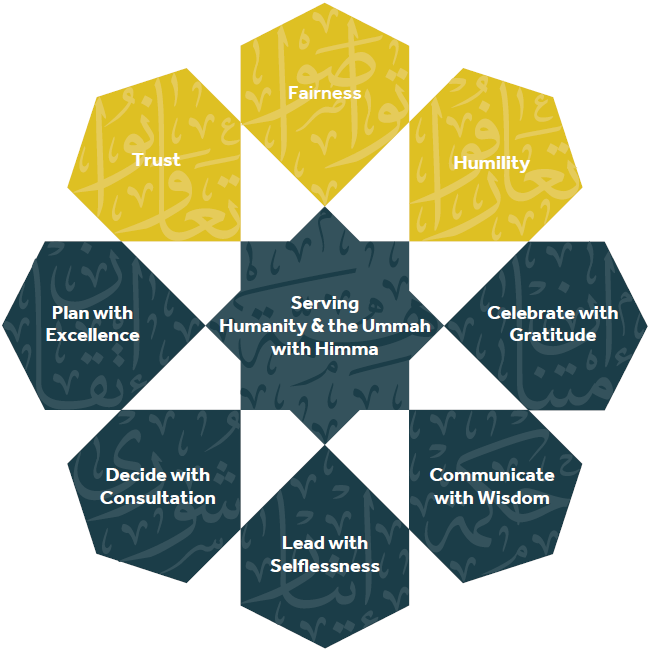
Which is why I'm a strong advocate for Muslim organizations to develop written culture codes — especially those that cross the 50 person mark. Name the mindsets, values, and behaviors you expect from everybody. Below are examples from two organizations I helped to develop their culture code based on Islamic principles:
The Islamic Development Bank, a multinational development bank built The IsDB Way — a culture code based on one core mindset, three foundational values, and five key behaviors.
LaunchGood, a crowdfunding platform, built theirs around four questions: why we exist, what we value, how we work, and who we are.
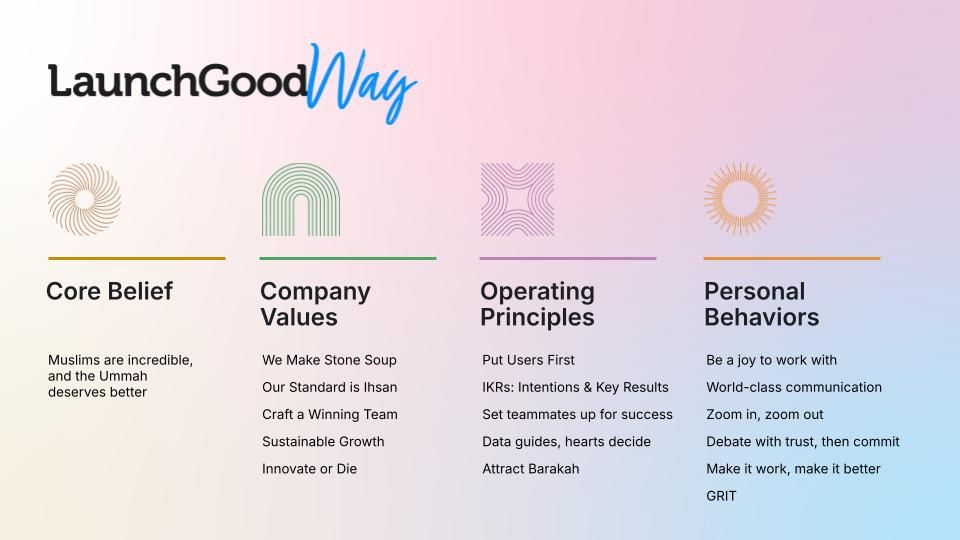
Both organizations use their culture codes when onboarding and have helped them communicate clearly how they want people to think and behave in their respective organizations.
So what does onboarding as an amanah actually look like?
Onboarding someone with amanah is ensuring that you've done your best to set them up for success, both logistically and culturally.
4. Managing Performance with Amanah
You've hired the best candidate you could find, negotiated a fair and dignified compensation package, and did your best with onboarding. But people are people, and they sometimes perform well and sometimes don't.
Often, performance management is outsourced to the HR department, where they set policies on how to review each employee annually or quarterly, and when to give feedback — and some of these reviews carry implications for promotions or layoffs.
Again, the underlying idea from the current HR perspective is how to manage people like machines on a factory floor, and optimize performance so we get the best bang for the buck.
But people aren't machines, and everyone has their circumstances. There's the young, ambitious, and energetic but unwise graduate. There's the busy professional juggling elderly sick parents and young kids. There's the single mother whose childcare arrangements are unpredictable and they have to miss deadlines multiple times.
How do you manage 'systematically' when people can't be managed like systems?
This is where managing with values makes sense.
What To Overlook, and What To Confront
One of the mind-boggling aspects of the Prophet's ﷺ leadership style comes from the hadith of Anas (may Allah be pleased with him), who served the Prophet ﷺ for ten years and said that he never once heard him ask, if he didn't do something, "Why didn't you do it?", and if he did something he wasn't supposed to do, "Why did you do that?"
I asked Sh. Abdul Nasir Jangda — the founder of Qalam Institute — this question: how do you balance this prophetic behavior — essentially, not giving feedback — with holding people accountable when they're not performing?
Sh. Abdul Nasir gave me a beautiful, balanced view. He said that Anas was the Prophet's ﷺ servant, and when it came to things related to the Prophet ﷺ himself, he never reprimanded or gave feedback. But when things related to Allah and the mission of Islam, he held people accountable. Case in point is the following incident in the seerah:
حَدَّثَنِي عَمْرُو بْنُ مُحَمَّدٍ، حَدَّثَنَا هُشَيْمٌ، أَخْبَرَنَا حُصَيْنٌ، أَخْبَرَنَا أَبُو ظَبْيَانَ، قَالَ سَمِعْتُ أُسَامَةَ بْنَ زَيْدٍ ـ رضى الله عنهما ـ يَقُولُ بَعَثَنَا رَسُولُ اللَّهِ صلى الله عليه وسلم إِلَى الْحُرَقَةِ، فَصَبَّحْنَا الْقَوْمَ فَهَزَمْنَاهُمْ وَلَحِقْتُ أَنَا وَرَجُلٌ مِنَ الأَنْصَارِ رَجُلاً مِنْهُمْ، فَلَمَّا غَشِينَاهُ قَالَ لاَ إِلَهَ إِلاَّ اللَّهُ. فَكَفَّ الأَنْصَارِيُّ، فَطَعَنْتُهُ بِرُمْحِي حَتَّى قَتَلْتُهُ، فَلَمَّا قَدِمْنَا بَلَغَ النَّبِيَّ صلى الله عليه وسلم فَقَالَ " يَا أُسَامَةُ أَقَتَلْتَهُ بَعْدَ مَا قَالَ لاَ إِلَهَ إِلاَّ اللَّهُ " قُلْتُ كَانَ مُتَعَوِّذًا. فَمَا زَالَ يُكَرِّرُهَا حَتَّى تَمَنَّيْتُ أَنِّي لَمْ أَكُنْ أَسْلَمْتُ قَبْلَ ذَلِكَ الْيَوْمِ.
"Narrated Usama bin Zaid: Allah's Messenger (ﷺ) sent us towards Al-Huruqa, and in the morning we attacked them and defeated them. I and an Ansari man followed a man from among them and when we took him over, he said, "La ilaha illal-Lah." On hearing that, the Ansari man stopped, but I killed him by stabbing him with my spear. When we returned, the Prophet (ﷺ) came to know about that and he said, "O Usama! Did you kill him after he had said "La ilaha ilal-Lah?" I said, "But he said so only to save himself." The Prophet (ﷺ) kept on repeating that so often that I wished I had not embraced Islam before that day."
Sahih al-Bukhari 4269
As a leader: if your team messes up your flight booking, forgets to send you that report, or does something that annoys you personally but doesn't impact the mission of the business, try to overlook it.
But if something is hurting a customer, a supplier, or a colleague, you need to hold them accountable — not in a negative way, but in a consultative way. Allah says in the Quran:
فَبِمَا رَحۡمَةٖ مِّنَ ٱللَّهِ لِنتَ لَهُمۡۖ وَلَوۡ كُنتَ فَظًّا غَلِيظَ ٱلۡقَلۡبِ لَٱنفَضُّواْ مِنۡ حَوۡلِكَۖ فَٱعۡفُ عَنۡهُمۡ وَٱسۡتَغۡفِرۡ لَهُمۡ وَشَاوِرۡهُمۡ فِي ٱلۡأَمۡرِۖ فَإِذَا عَزَمۡتَ فَتَوَكَّلۡ عَلَى ٱللَّهِۚ إِنَّ ٱللَّهَ يُحِبُّ ٱلۡمُتَوَكِّلِينَ ١٥٩
"So by mercy from Allāh, [O Muḥammad], you were lenient with them. And if you had been rude [in speech] and harsh in heart, they would have disbanded from about you. So pardon them and ask forgiveness for them and consult them in the matter. And when you have decided, then rely upon Allāh. Indeed, Allāh loves those who rely [upon Him]."
Surah Ali 'Imran [3:159]
Notice the set of instructions:
- Pardon them.
- Ask Allah's forgiveness for them.
- Consult them.
Most of us skip all of the above and go straight to reprimanding and holding someone accountable — often publicly — so we can exercise our ego and let our nafs take its revenge.
But when did you last make dua for the team member who frustrated you? I'd argue the single most neglected performance management practice available to us is to make dua for our team members, that they improve and become better (just like for parents, the most powerful tool to help our children improve is to constantly make dua for them).
So the general rule of performance management from an Islamic worldview is this:
To be clear, I'm not asking you to be a doormat, letting your employees do whatever they like and take advantage of your leniency. I'm asking you to be a shepherd. Thinking holistically about your entire flock, and how to work with each individual member of it, so that all of you can reach greener pastures.
How To Hold Someone Accountable
If accountability is necessary, then how you do it matters. Below are some tips:
Review Processes, not Outcomes
As I wrote in my article “How to Set Goals Like A Gardener?” I'm not a big fan of 10-year vision boards, or 5 year goals, because often we don’t know what success looks like in 5-10 years time, nor do we have control over all the factors that can lead to those images of success.
Similarly, I’m not in favor of the OKR methodology (Objectives and Key Results) which tends to be very outcome focused, because often we don’t have control over the outcome nor the factors that would lead us there.
Rather, I like how the LaunchGood team rebranded OKRs to IKRs (Intentions and Key Results).
This makes the performance review conversation focused on:
- What did you intend this year/quarter?
- And what did you actually do about it?
- How did you do it? I.e. Did you live up to the culture code or not?
That’s a much healthier conversation than a conversation if someone achieved a specific outcome or not that is often beyond their control.
How To Bring Barakah Into Your Performance Conversations
One of my friends uses the Barakah Culture Cards during the annual performance conversations he has with his colleagues. He said it helped ground the conversation in the mindsets, values, and behaviors that need to improve for next year, instead of objectives and goals that are often outside the person's control.
Ideally, performance management should be self-driven by the employee: they want to do better and excel, and they ask their leaders how to improve. A man came to Prophet Muhammad (peace be upon him) and said "advise me" and was told, "do not become angry". (Bukhari)
Lastly, separate the performance review conversation from the money conversation. Often performance reviews are linked to bonuses, and salary growth, and this makes the person defensive about their performance instead of genuinely listening for ways they can improve for the following year.
And Who Manages Your Performance?
As business leaders, we are quick to judge and review our employees. But who reviews us? Especially if we don't have a board or shareholders to answer to.
If you're the leader, I recommend you create a safe environment where your employees can give you feedback without fearing repercussions, and that you have a personal circle of mentors or peers who can be your mirror and give you honest feedback on your leadership.
Managing the performance of the entire flock is the shepherd's responsibility. But don't forget to manage your own performance too.
5. Managing People's Spirituality as an Amanah
You won't find this in any corporate HR playbook, and sadly you'll find it in very few Muslim companies either. But I wanted to write it, because I think it's the most important part of this article.
Your employees spend the bulk of their waking adult life inside your company. Forty, fifty, sixty hours a week. More hours awake with you than with their spouse or their children.
Is it not a tragedy that someone could give you five, ten, fifteen years of their life and walk out spiritually exactly where they walked in? Or worse, further back?
If they're an amanah, then their spiritual state whilst under your care is part of your responsibility.
You might think that someone’s spirituality is none of your business — but again, if I treat people as a trust Allah has given me — part of taking care of this trust is to ensure that at least I become a means of them coming closer to Allah SWT.
One of the unique qualities of this ummah is that we’re an ummah that enjoins the good and forbids the evil, and that characteristic needs to start at home and in our companies:
كُنتُمۡ خَيۡرَ أُمَّةٍ أُخۡرِجَتۡ لِلنَّاسِ تَأۡمُرُونَ بِٱلۡمَعۡرُوفِ وَتَنۡهَوۡنَ عَنِ ٱلۡمُنكَرِ وَتُؤۡمِنُونَ بِٱللَّهِۗ
"You are the best nation produced [as an example] for mankind. You enjoin what is right and forbid what is wrong and believe in Allāh. If only the People of the Scripture had believed, it would have been better for them. Among them are believers, but most of them are defiantly disobedient."
Surah Ali 'Imran [3:110]
The Prophet (ﷺ) said:
حَدَّثَنَا أَبُو نُعَيْمٍ، حَدَّثَنَا زَكَرِيَّاءُ، قَالَ سَمِعْتُ عَامِرًا، يَقُولُ سَمِعْتُ النُّعْمَانَ بْنَ بَشِيرٍ ـ رضى الله عنهما ـ عَنِ النَّبِيِّ صلى الله عليه وسلم قَالَ " مَثَلُ الْقَائِمِ عَلَى حُدُودِ اللَّهِ وَالْوَاقِعِ فِيهَا كَمَثَلِ قَوْمٍ اسْتَهَمُوا عَلَى سَفِينَةٍ، فَأَصَابَ بَعْضُهُمْ أَعْلاَهَا وَبَعْضُهُمْ أَسْفَلَهَا، فَكَانَ الَّذِينَ فِي أَسْفَلِهَا إِذَا اسْتَقَوْا مِنَ الْمَاءِ مَرُّوا عَلَى مَنْ فَوْقَهُمْ فَقَالُوا لَوْ أَنَّا خَرَقْنَا فِي نَصِيبِنَا خَرْقًا، وَلَمْ نُؤْذِ مَنْ فَوْقَنَا. فَإِنْ يَتْرُكُوهُمْ وَمَا أَرَادُوا هَلَكُوا جَمِيعًا، وَإِنْ أَخَذُوا عَلَى أَيْدِيهِمْ نَجَوْا وَنَجَوْا جَمِيعًا " .
"Narrated An-Nu`man bin Bashir: The Prophet (ﷺ) said, "The example of the person abiding by Allah's order and restrictions in comparison to those who violate them is like the example of those persons who drew lots for their seats in a boat. Some of them got seats in the upper part, and the others in the lower. When the latter needed water, they had to go up to bring water (and that troubled the others), so they said, 'Let us make a hole in our share of the ship (and get water) saving those who are above us from troubling them. So, if the people in the upper part left the others do what they had suggested, all the people of the ship would be destroyed, but if they prevented them, both parties would be safe.""
Sahih al-Bukhari 2493
Imagine your company is that ship. If you don't enjoin the good or forbid the evil at your company, you might be allowing holes to be drilled that affect you all spiritually in this world and the next.
I’m not asking you to be a religious police, and in the end, you can’t force people to change or become pious, but I ask you to do your part to encourage people to get closer to Allah (SWT) either with role modeling mindsets such as taqwa and values such as Ihsan, or encouraging rituals such as Salah and Dua at your company. As Allah says in the Quran in the story of the Sabbath-breakers:
وَإِذۡ قَالَتۡ أُمَّةٞ مِّنۡهُمۡ لِمَ تَعِظُونَ قَوۡمًا ٱللَّهُ مُهۡلِكُهُمۡ أَوۡ مُعَذِّبُهُمۡ عَذَابٗا شَدِيدٗاۖ قَالُواْ مَعۡذِرَةً إِلَىٰ رَبِّكُمۡ وَلَعَلَّهُمۡ يَتَّقُونَ ١٦٤
"And when a community among them said, "Why do you advise [or warn] a people whom Allāh is [about] to destroy or to punish with a severe punishment?" they [the advisors] said, "To be absolved before your Lord and perhaps they may fear Him.""
Surah Al-A'raf [7:164]
So part of your role as a leader is to enjoin what is good and forbid what is harmful. Not as moral policing, but as a survival function for the ship you’re steering.
Protect Your People from Shaytaan
I've written an article on how Shaytaan influences the workplace and I am surprised how often we don’t relate issues such as envy, arrogance, anger, backbiting, harassment to shaytaan and his influences.
We seem to have this amnesia when we enter the workplace and assume that shaytaan won’t be there or affect how we work together.
And when inter-personal issues occur we often outsource this to HR and expect them to run code of conduct workshops and anti-harassment training modules.
But these are spiritual battles that you can't HR your way through them. You need a proper tarbiyah and tazkiyah programme to help everyone manage their individual battles with their nafs and shaytaan.
I once spoke to the Ombudsman of a large bank, a man whose entire job was handling internal complaints and disputes across thousands of employees. I asked him what his biggest challenge was. He said: "Envy."
There’s no HR policy that can deal with envy. But Islam came with a set of tools to treat every spiritual disease including envy.
This is why, for a few years now, I've been advocating for a role I call the Chief Murabbi Officer. A person whose job is to focus on the spiritual development of all employees in your company.
I understand that not every organization can appoint a Chief Murabbi Officer. But every organization can start attending to the spiritual environment its people work inside. Here's where I'd begin.
If one of your employees gives you the next fifteen years of their life, will their heart be in better condition than when they first walked in or not?
6. Offboarding as an Amanah
We've walked through hiring, paying, onboarding, managing performance, and nurturing people spiritually.
Now the hardest part. Letting people go.
The reality of life is that every single person you hire will eventually leave: whether they resign, retire, get let go, or Allah takes them. Nobody stays with you forever. And how the relationship ends says more about you as a leader than how you hire them.
One of my friends had an engineer who served his company for decades. The man died while still on the job, leaving behind a wife and children. My friend kept paying his family his full salary and it's been years now. He wasn't legally obliged to. Nobody would have thought less of him for a generous one-off payment. But this is what I mean when I say you manage people as an amanah. The trust doesn't end when the contract does or you’re legally not responsible for a person. You carry on the amanah to the best of your ability.
When Someone Chooses To Leave
When someone good chooses to leave us; often as leaders we see that as a betrayal. “After all I’ve done for you...”
But if we truly believe that we were simply ‘caretakers’ of an amanah, and a channel for someone’s rizq for a season, then their resignation stops feeling like a betrayal and becomes what it is: the end of a chapter in your life and their life.
Musa served his full ten years with Prophet Shoaib (peace be upon him), and after that he left with his family and moved on. There was no indication of any grievance on either side.
One organization I worked for had a very successful young professional program, a 2-year program where the organization invested a lot of money in the promising graduates hoping they’d become the next leaders of the organization. Unfortunately, some of these young professionals would leave as soon as the program was over, and when the president of the organization was asked whether he was upset that these young professionals are leaving before they’ve contributed back to the organization, he replied: they are our contribution to the ummah.
So how do you handle someone's resignation with Ihsan?
When You Have To Let Someone Go
I don't think there's any easy way to let someone go: Sometimes a person simply cannot fulfill the responsibility of the role, and they have to be let go. Other times, the person is not a good fit for the company culturally and keeping them may cause more harm than good (of course, there’s a third scenario of someone being unethical, but that’s a clear decision of termination).
How to let go of such people with Ihsan?
Conclusion
I thought about why leaders prefer to treat human beings as resources, and I realized it’s because it’s easier:
- It’s easier to hire without scrutiny since you can get rid of them quickly if they don’t fit.
- It’s easier to pay them as low as possible without consideration for their dignity.
- It’s easier to give lip service that “people are our greatest asset” and not mean it when the share price demands layoffs.
But when you think of people as amanah (responsibility) just like your family or community and that you’ll be questioned about this amanah, you’ll be more thoughtful and careful.
Umar ibn al-Khattab said that if a mule were to stumble on a road in Iraq, he feared Allah would ask him why he hadn't levelled the road for it.
If Umar feared being questioned about a mule that stumbled on a road, what makes us think we won’t be questioned about the people whom we manage every day?
I've offered a lot of ideas in this article, and I'm sure some of you will disagree with plenty of them. Some won't survive contact with your industry, or your board. That's fine. I'm not offering a finished Islamic HR model. I'm trying to start a conversation that I think our Ummah is overdue: What does an Islamic corporate culture actually look like in practice? And it starts with how we manage people.
I'd love to hear your thoughts and feedback in the comments below.
I pray this article becomes the impetus for our Ummah to rethink HR from an Islamic perspective in a meaningful and practical way.
Any errors in this article are from myself and shaytaan, and any good is from Allah.
May Allah enable us to manage people with amanah and Ihsan.
Want to help protect your team's spiritual health at work? Download Antidotes to Fight Satan in the Workplace — a free infographic breaking down 10 common ways Satan influences us at work, paired with practical, sunnah-rooted antidotes:



![[Productive Professionals] Qualities of a Productive Manager](https://cdn.sanity.io/images/2sxb14me/production/d3f07bc8a54bc00fbb53fb42db426858412c5318-600x450.png)