The best gift to a child by his parents is his proper upbringing. But it can be confusing and daunting with so many theories of good parenting practice to follow. No wonder most parents find it hard to raise productive and pious children! To make it easy for parents, I have narrowed down the Islamic parenting to five essential principles. If we take action on these five principles, then it will help guide us and make us productive parents raising productive children.
Children are an amanah for us as Muslims, a responsibility as much as they are a gift. It is our job to make sure they become hard-working, productive and most importantly, God-fearing individuals who will be an asset to the Ummah. The Prophet Muhammad ﷺ said:
"When a man dies, his action discontinues from him except three things, namely, perpetual sadaqah (charity), or the knowledge by which benefit is acquired, or a pious child who prays for him."
Sunan Abi Dawud 18
So our intention and aim when raising our children should be to make them a benefit for us and themselves for the Hereafter. To achieve this aim, here are the five principles that are essential to ingrain while we undertake our daily tasks of caring for our children:
Principle 1: Children are born pure
A person’s behavior can be interpreted in two ways: the first is that actions are assumed to be influenced by his internal characteristics; and the second is in which the possible causes of a person’s actions are related to his situation. This is the theory of attribution in social psychology. However, Allah’s ﷻ Messenger ﷺ said:
"No child is born except on al-fitra (Islam or primordial human nature) and then his parents make him Jewish, Christian or Magian, as an animal produces a perfect young animal: do you see any part of its body amputated?"
Sahih Muslim 46
This hadith states that Allah ﷻ has created children pure, sinless and with a natural predisposition for good and a belief in the one God, i.e. there is a zero possibility of the child being influenced by his internal characteristics to misbehave. Hence, no blame can be placed on a child if he does anything wrong, especially till he reaches the age of 10. No child has any intention of doing wrong except that he is only imitating or applying what he has seen, heard, felt and learnt from his environment.
What we get to see is when the child does something displeasing to his parents, he is immediately scolded and blamed. Parents must realize that he is only acting on what he sees, hears and feels. It could be that he has copied the behavior from what went on around him.
Principle 2: Parents are guides and role models
When children are young, they are still in the process of learning what is right and what is wrong, and the correct way to behave in their environment. It is the parents’ responsibility to teach the child how to do this, how to choose his environment and decide which type of people to fill that environment with, so that they can continue to do what is good and pure. Allah’s Messenger ﷺ said,
"Everyone of you is a guardian and is responsible for his charges. The ruler who has authority over people, is a guardian and is responsible for them; a man is a guardian of his family and is responsible for them; a woman is a guardian of her husband’s house and children and is responsible for them; a slave is a guardian of his master’s property and is responsible for it; so all of you are guardians and are responsible for your charges."
Sahih al-Bukhari 67
The child is new to the world so he does not yet know what to do. He has an innate nature to be good, but it needs to be nurtured. His parents are the ones charged with this responsibility to lead, guide and take care of him. If left alone, the child could go either way depending on who he meets and interacts with. If his parents take this responsibility seriously to ensure he grows on al-fitr and obeys Allah ﷻ and His Messenger ﷺ then he will very likely to continue to do what is good and pure.
Principle 3: The essentials of upbringing are kindness and mercy
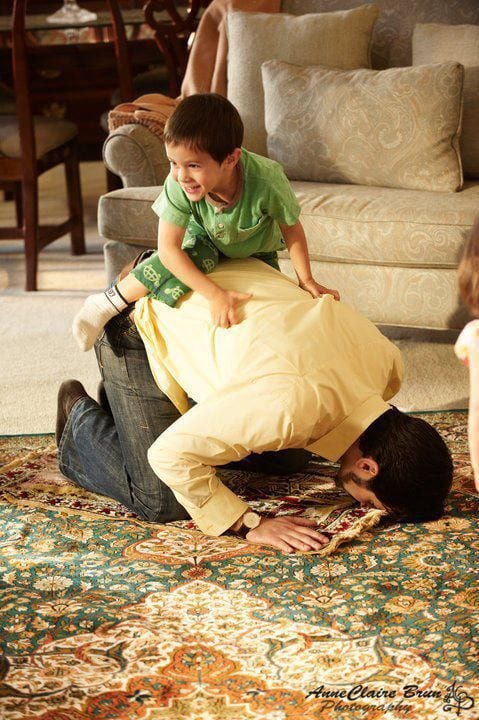
One of the qualities of a great leader is that you care for those whom you are leading. Prophet Muhammad ﷺ had this quality. He ﷺ treated everyone with kindness and mercy (even to his enemies whom he did not lead). Our Prophet ﷺ was kinder to children, whom he would let climb over him while in prostration.
"It was narrated from ‘Abdullah bin Shaddad that his father said: “The Messenger of Allah came out to us for one of the nighttime prayers, and he was carrying Hasan or Husain . The Messenger of Allah came forward and put him down, then he said the Takbir and started to pray. He prostrated during his prayer, and made the prostration lengthy.” My father said: “I raised my head and saw the child on the back of the Messenger of Allah while he was prostrating so I went back to my prostration. When the Messenger of Allah finished praying, the people said: “O Messenger of Allah , you prostrated during the prayer for so long that we thought that something had happened or that you were receiving a revelation.’ He said: ‘No such thing happened. But my son was riding on my back and I did not like to disturb him until he had had enough."
Sunan an-Nasa'i 12
How many parents do you know would let their child climb all over them while praying? As it is one of the pillars of Islam, you may become angry with your child for climbing on your back and sitting on your head. However, the Prophet Muhammad ﷺ understood that it is in a child’s nature to play, and therefore he ﷺ did not stop them. We must understand that playing and ‘kidding’ are vital for the proper development of a child, as they benefit his physical, emotional, cognitive and social development.
"In another hadith narrated by`Aisha , A bedouin came to the Prophet and said, “You (people) kiss the boys! We don’t kiss them.” The Prophet said, “I cannot put mercy in your heart after Allah has taken it away from it."
Sahih al-Bukhari 78
We know how important cuddles are for infants to make them feel safe and happy. Physical affection should not be stopped when your child grows up. Of course, you can limit it as your child gets older, but never put an end to it.
Principle 4: Where should you draw the line for your children?
Allah ﷻ has given us boundaries to keep within. The Messenger of Allah ﷺ said,
"Verily Allah the Almighty has laid down fara’id (religious obligations), so do not neglect them. He has set boundaries, so do not overstep them. He has prohibited some things, so do not violate them; about some things He was silent, out of compassion for you, not forgetfulness, so seek not after them."
Nawawi's 40 Hadith 30
Without boundaries, society would be in chaos as anyone can do anything and infringe others’ rights. The same goes with the child. He needs a set of boundaries to guide his behavior, which gives the child the freedom to act and behave within them. If he does not know what the boundaries are then he will always be testing you with his behavior to see what is acceptable and what is not.
If the child is taught beforehand what is correct and good behavior, then he will have the guidelines to act within the boundaries and will not be left wondering and confused.
Principle 5: Small responsibilities for the small shoulder to make it big!
As each of us is responsible for what is in our care, so too does the child need to be taught responsibility. Being responsible teaches the child to be independent, but also dependable, reliable and productive. It makes him feel that he has a role in the family and a role in society instead of feeling useless. He will develop a sense of belonging and be a useful member of the family and society. It will give him purpose instead of acting up out of frustration and uselessness. It also helps to teach children about being responsible for their actions. Allah ﷻ says in the Qur’an that each of us is responsible for our actions:
كـَلَّا وَٱلۡقَمَرِ ٣٢ وَٱلَّيۡلِ إِذۡ أَدۡبَرَ ٣٣ وَٱلصُّبۡحِ إِذَآ أَسۡفَرَ ٣٤ إِنَّهَا لَإِحۡدَى ٱلۡكُبَرِ ٣٥ نَذِيرٗا لِّلۡبَشَرِ ٣٦ لِمَن شَآءَ مِنكُمۡ أَن يَتَقَدَّمَ أَوۡ يَتَأَخَّرَ ٣٧ كُلُّ نَفۡسِۭ بِمَا كَسَبَتۡ رَهِينَةٌ ٣٨
"No! By the moon And [by] the night when it departs And [by] the morning when it brightens, Indeed, it [i.e., the Fire] is of the greatest [afflictions] As a warning to humanity - To whoever wills among you to proceed or stay behind. Every soul, for what it has earned, will be retained"
Surah Al-Muddaththir [74:32-38]
Giving responsibility at an early and appropriate age helps the child realize that if he does not do what he is supposed to then it will affect others and let them down. It also prepares the child for when the time comes for him to be fully responsible so he will not be taken by surprise. This does not mean to overburden him but to give him jobs that he can be in charge. Start at around preschool age because telling your teenager to do his chores out of the blue does not work! It needs to be done gradually over the childhood years, adding more as the child slowly heads towards maturity.
These are the five basic principles of Islamic parenting. It makes parenting a little bit easier when you take action on them. Once you have, you might like to find out if you have the Top 5 Qualities of a Muslim Parent. Also, please share with us in the comments how you are going to implement these principles in your home and what are your action plans.
Looking for a way to bring these lessons to life for your children? The Barakah Tree, Mohammed Faris' debut children's book, tells the story of young Kareem learning that sincerity, patience, and ihsaan don't always bring instant results — but they bear the sweetest, most unexpected fruits. A beautifully illustrated bedtime story that plants these same values in your child's heart: